PADI and SSI Scuba Diving Certification in Cancun
There is a specific kind of quiet that happens the second your ears slip beneath the surface of the Caribbean. The chaotic hum of Cancun boat engines, the hotel music, and the chatter from the docks simply vanish, replaced by the rhythmic hiss of your own breath moving through a second-stage regulator. Getting your cancun scuba diving certification turns what could be an ordinary beach trip into a passport for the rest of the planet. Warm water, shallow sand flats for drills, and clear visibility make this stretch of Quintana Roo one of the friendliest places anywhere to learn.
Deciding to get certified here is smart, but the logistics can get confusing fast. You have to pick an agency, figure out whether to study at home or on vacation, and decide which dive shop will keep you safe without rushing you through skills. Both PADI and SSI operate across the hotel zone and downtown marinas. The training follows global standards, yet local conditions shape how you learn. This guide walks you through the agencies, the training days, what you will spend, and how to finish your open water license without burning your entire vacation sitting in a classroom.
Choosing Your Cancun Scuba Diving Certification Agency: PADI vs SSI
People love to argue about whether PADI or SSI is better. Honestly, both organizations answer to the World Recreational Scuba Training Council, which means the safety protocols, dive tables, and skill requirements are almost identical. An open water card from either agency lets you rent tanks, hop on dive boats, and explore down to 18 meters (60 feet) anywhere in the world. The ocean does not care which plastic card is in your wallet.
The real differences come down to how the agencies package their materials and how flexible instructors can be with the syllabus. PADI (Professional Association of Diving Instructors) is the giant of the dive industry. If you walk into a dive shop on a remote island in Southeast Asia, they definitely know PADI. SSI (Scuba Schools International) has grown massively because their digital platform is slick, and their training system allows instructors to shuffle the sequence of water skills depending on weather or student comfort. If you panic while trying to clear your mask, an SSI instructor can pause, switch to buoyancy work, and return to the mask skill later without breaking agency rules. PADI requires a more rigid progression through specific modules.
Cost is another factor where the two split. SSI generally runs slightly cheaper because their digital learning kits cost dive centers less wholesale. PADI materials carry a premium, and you own the digital manual for life via their app. With SSI, your certification remains active in their app forever, but if you do not log in for over a year, offline access to the manual can require a quick refresh online. If you are doing a beginner scuba diving discovery dive first to test the waters, many shops will credit that cost toward either agency's full course.
| Feature | PADI Open Water | SSI Open Water |
|---|---|---|
| Average Cancun Price | $470 - $540 USD | $420 - $480 USD |
| Training Sequence | Strict modular order | Flexible skill order |
| Digital Materials | PADI App (lifetime offline) | MySSI App (active account needed) |
| Global Recognition | Universal (largest agency) | Universal (second largest agency) |
| Checkout Dives Needed | 4 open water dives | 4 open water dives |
Do not lose sleep over the agency logo. Pick the shop that communicates clearly, answers your safety questions directly, and has small group sizes. A bad instructor can make the best training agency feel terrifying, while a patient instructor makes a tough day in the water feel effortless.
Book your cancun scuba diving experience:
How the Cancun Scuba Certification Process Actually Works
The full open water diver course consists of three distinct phases: academic theory, confined water training, and four open water checkout dives. Most people finish in three days. Some push through in two long, exhausting days, but taking three allows your brain to absorb the physics while your body rests between dives.
Phase one is the theory. You learn about pressure changes, lung overexpansion injuries, nitrogen absorption, and dive planning. You can sit in a chilly air-conditioned classroom in Cancun reading manuals, but almost nobody does that anymore. Instead, you do e-learning on your phone or laptop before leaving home. You arrive with your digital quizzes already passed, leaving only a brief review quiz for your instructor to verify you did not let your cousin take the tests for you.
Pro tip: Finish every page of your online theory before boarding your flight. Spending your Caribbean evenings trapped in a hotel room reading about decompression sickness while your friends are drinking margaritas downstairs is a miserable way to spend vacation.
Phase two takes you into confined water. In Cancun, this usually means a purpose-built resort pool or a crystal-calm, shallow bay in the Nichupté Lagoon or near Isla Mujeres. You assemble your gear: sliding the BCD onto the cylinder, connecting the low-pressure inflator hose, checking your tank pressure, and testing the primary and alternate regulators. Then you submerge. You learn how to breathe underwater, how to find your regulator if it gets knocked out of your mouth, and how to flood your mask with seawater and blow it clear using your nose. You will also practice out-of-air scenarios, sharing air with a buddy and ascending safely.
Phase three is where the magic hits: four open ocean dives spread over two days. On dives one and two, your maximum depth is capped at 12 meters (40 feet). You repeat several skills you practiced in the pool, like hovering weightless or swapping regulators, and then spend the remaining tank air exploring the reef. Dives three and four push down to a maximum of 18 meters (60 feet). Once you surface from dive four, sign your logbook, and pass the final debrief, you are officially a certified diver.
Best Training Sites for Your Cancun Scuba Diving Class
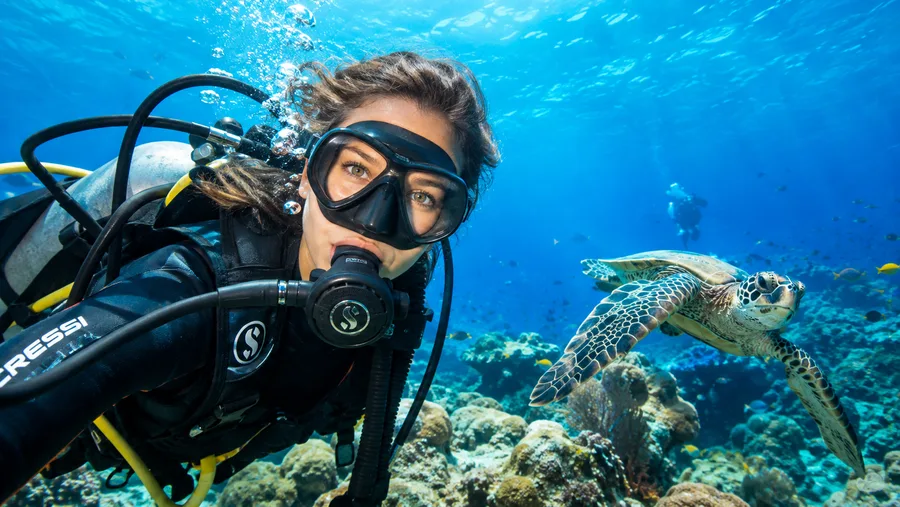
Cancun training dives are rarely done in deep, moody water. Dive operators here rely on shallow, sunlit reef systems that sit between the Cancun hotel strip and Isla Mujeres. The water hovers around 80 degrees Fahrenheit most of the year, meaning a 3mm shorty wetsuit or even just a rashguard is all you need to stay comfortable.
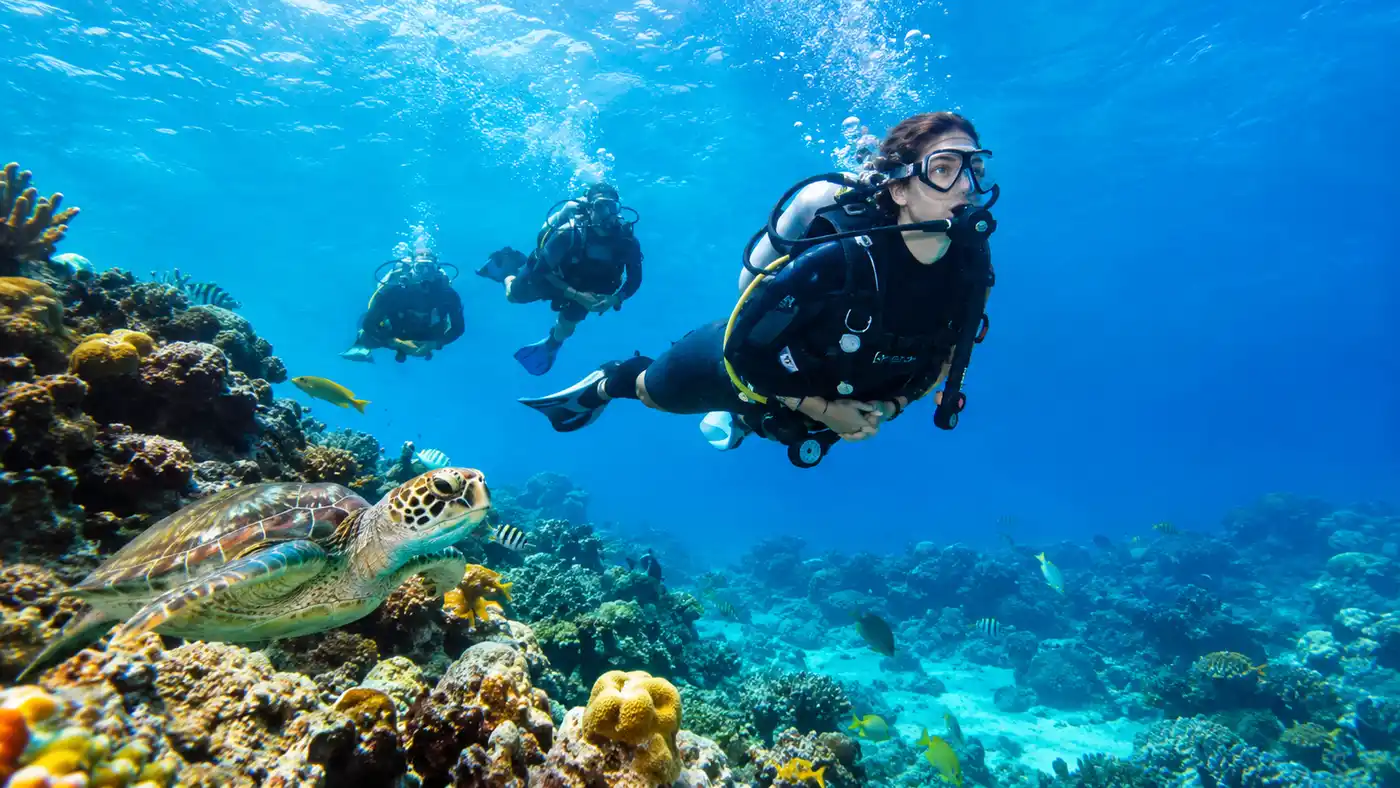
Instructors love Manchones reef for training dives three and four. It sits about 30 feet down, protected from heavy swell by the island. The bottom is bright white sand dotted with massive brain corals, sea fans, and schools of yellowtail snapper. Because the bottom is sand, students can practice kneeling for skills without crushing fragile living coral. You will often see green sea turtles grazing on seagrass nearby, completely unbothered by students fumbling with their buoyancy compensators.
You might also do checkout dives at the famous Cancun Underwater Museum (MUSA). The Manchones section of MUSA features hundreds of life-sized concrete sculptures covered in young coral polyps. Performing a mask-clearing drill while hovering next to a sunken VW Beetle or a crowd of life-sized statues is an surreal memory you will never forget. For shallow checkout dives one and two, reefs like Chitales or El Meco offer gentle conditions with depths around 15 to 25 feet, giving you a safe margin for error while you figure out how your lungs control your vertical position.
- Manchones Reef: Ideal depth of 30 to 35 feet, flat sandy patches, zero current on good days, and reliable turtle sightings.
- MUSA Silent Evolution: Depth of 28 to 32 feet, incredible backdrop for beginner drills, excellent water clarity.
- Chitales: Very shallow at 18 to 22 feet, calm water, schools of grunts, perfect for first-time ocean submersions.
- Punta Nizuc: Located at the southern tip of the hotel zone, shallow reef with abundant marine life, though visibility can drop if wind picks up.
Book your cancun scuba diving experience:
Course Formats: Full Certification vs. Referral Courses
You do not have to do the entire course in Mexico. Many travelers choose a universal referral course. This split option lets you complete your theory and your confined pool sessions with a local dive shop near your home during the weeks before your trip. Your hometown instructor signs off on your referral paperwork, verifying that you know how to assemble gear and clear your mask.
Once you touch down in Mexico, you simply hand that paperwork to a certified Cancun scuba diving school. You skip the pool entirely and complete only your four ocean checkout dives over two mornings. It saves you vacation time, keeps you out of resort pools, and lets you spend your Cancun hours actually exploring the ocean reefs instead of practicing drills on the pool steps.
Note: Dive referral forms are valid for 12 months from the date of your last completed session, but waiting more than a couple of months means you will likely need a quick pool refresher before an instructor takes you into the open ocean.
A full resort course, on the other hand, keeps everything in one basket. You start from scratch on day one at the marina, meet your instructor, do your pool work, and finish your ocean dives with the same person. There is real value in having one instructor watch your progress from your very first nervous breath in the pool all the way down to your final 50-foot drift across Manchones reef.
Costs, Hidden Fees, and Gear Realities
A full PADI open water certification cancun package typically runs between $460 and $550 USD. SSI programs hover around $420 to $480 USD. If you opt for the referral program where you only do the four ocean dives, expect to pay around $280 to $340 USD. These prices usually cover your study materials, certification card processing fees, boat charters, tanks, weights, and basic rental gear.
Look out for the extra charges that pop up on arrival. The Mexican government levies a National Marine Park fee and dock usage fee on boats departing Cancun marinas. This fee is usually between $12 and $15 USD per person per boat day, payable in cash at the marina counter. Some shops bundle it into their pricing, but most leave it out of the base quote. Wetsuit rentals might also be an add-on; while some shops include them, others charge $10 per day if you want thermal protection beyond your swimsuit.
- Base course fee: Covers instruction, boat trips, and digital certification card ($420 - $550).
- National Marine Park and dock fees: Budget about $15 per boat day, usually cash only.
- Mask and snorkel purchase: It is worth spending $50 to $80 at home on a mask that fits your face properly, rather than using a leaky rental.
- Instructor gratuities: Mexican dive guides and instructors work hard; 15% to 20% tip for good service is standard practice.
After certification, many divers immediately want to level up. If you find your footing quickly, you can roll straight into advanced training. Taking your advanced open water certification lets you hit 30 meters (100 feet), opening up deeper shipwrecks and nearby adventures like drift diving along deep walls or exploring deep sinkholes throughout the Yucatan Peninsula.
Skills That Trip Beginners Up (and How to Handle Them)
Almost everyone hits a mental wall during their scuba diving certification in cancun. For nine out of ten students, that wall is mask clearing. Deliberately letting cold seawater flood your mask while you are 20 feet under the surface triggers a primitive human panic reflex. Your brain screams that you are drowning, even though your regulator is delivering plenty of dry air.
The trick is simple. Close your eyes if the salt burns. Take two slow, deep breaths through your mouth to calm your nervous system. Place your fingers on the top frame of your mask, tilt your chin upward toward the surface, and exhale steadily through your nose. The air pushes the water out the bottom skirt of the mask. It takes two seconds. Once you do it three times in the pool, the fear evaporates.
Equalizing your ears is another hurdle. Do not wait until your ears hurt to equalize. As soon as your head dips beneath the surface, pinch your nose and blow gently. Do it every two feet of descent. If an ear refuses to pop, stop, signal your instructor, ascend three feet until the pressure releases, and try again. Never force it. The Caribbean will still be there if you take two extra minutes to reach the bottom.
Frequently Asked Questions about cancun scuba diving certification
How many days does it take to get certified in Cancun?
A standard open water diver certification takes three full days. If you complete your theory and confined pool training at home via a referral program, you can complete the four required ocean checkout dives in Cancun in two half-days.
Can I fly immediately after completing my scuba certification course?
No. You must wait at least 18 hours after completing multiple dives before flying on a commercial airplane. Many training agencies recommend a 24-hour window to minimize any risk of decompression sickness. Plan your training for early in your vacation.
Do I need to be a strong swimmer to get scuba certified?
You do not need to be an Olympic athlete, but you must pass two basic watermanship tests: a 200-meter continuous swim (or 300 meters with mask, fins, and snorkel) with no time limit, and a 10-minute survival float or tread in water too deep to stand.
Is Cancun a good place for beginners compared to Cozumel?
Cancun is generally easier for beginners than Cozumel. Cozumel is famous for strong drift diving, which requires solid buoyancy and quick descents in heavy currents. Cancun features shallower reefs, gentler water movement, and broad sandy bottoms that are far more forgiving for nervous students.
Quick Reference
- Duration: 3 full days (or 2 half-days with a referral)
- Average Cost: $420 to $550 USD depending on agency
- Depth Limit: 18 meters (60 feet) upon completion
- Minimum Age: 10 years old for Junior Open Water
- No-Fly Surface Interval: 18 to 24 hours post-dive
Book your cancun scuba diving experience:
The Bottom Line
Learning to dive is one of those rare decisions that permanently changes how you look at the planet. Instead of staring at the blue line of the horizon from a lounge chair, you get to step over the side of the boat and see what is happening underneath. Cancun gives you warm water, low stress, and shallow coral gardens that make your initial learning curve as painless as possible. Complete your bookwork before you pack your bags, choose an instructor who takes their time, and take that first breath beneath the waves. The rest comes naturally.
Read more about cancun scuba diving.